Bridging the Gap Between Bench Science and Clinical Care
In the field of brain health, expertise is defined by those who stay at the leading edge of discovery. For our concierge and direct-access clients, the value of an evaluation lies in its scientific foundation. We believe that a neuropsychological assessment should not merely rely on decades-old standards, but should be guided by the most current evidence—often generated by the very clinicians conducting the evaluation.
Our practice is defined by active contribution to the global scientific community, with research featured by Oxford University Press, Frontiers in Human Neuroscience, American Academy of Clinical Neuropsychology (AACN) and the National Academy of Neuropsychology (NAN).
Innovation in Teaching and Testing: The AACN Workshop
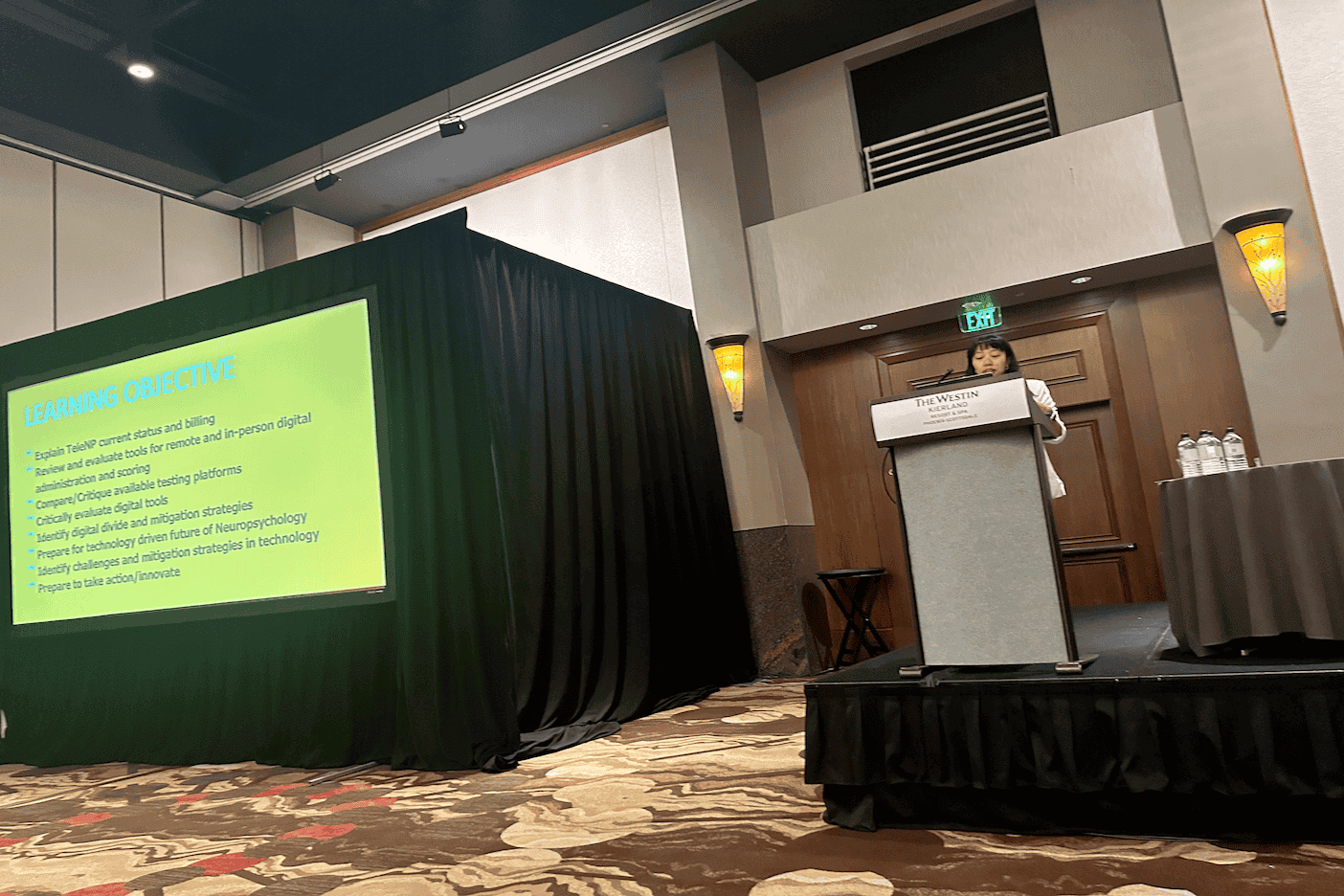
Our commitment to the field is evidenced by our leadership in professional education. In June 2024, alongside esteemed colleagues from UCLA and other institutions, we presented the workshop 'Technology and innovation in neuropsychological teaching, testing, and treatment: Practical solutions for practitioners and educators' at the AACN 2024 Conference. This work defines the national standard for modern, tech-integrated brain care, ensuring that the tools we use in your evaluation are the most valid and reliable instruments available today.
Optimizing Diagnostic Accuracy and Efficiency
For high-achieving professionals, time is a finite resource. Our research actively explores the balance between testing depth and efficiency. In the manuscript 'Battery Length as a Moderator of Classification Accuracy for Cognitive Impairment' (published in Archive of Clinical Neuropsychology), we utilized Monte Carlo simulation studies to determine how to achieve maximum diagnostic certainty in the shortest possible timeframe. This ensures your concierge evaluation is high-yield and scientifically rigorous.
Advanced Brain Mapping and Executive Functioning
Understanding how the brain communicates is critical for diagnosing complex conditions like ADHD and Frontotemporal Dementia. Our 2025 publication in Frontiers in Human Neuroscience, 'Hubs, influencers, and communities of executive functions: A task-based fMRI graph analysis,' applies advanced graph theory to map the brain's functional connectivity. By identifying the specific neural 'hubs' that manage initiation and inhibition, we provide a more sophisticated interpretation of your cognitive strengths and weaknesses.
Predictive Modeling and Traumatic Brain Injury
We are pioneers in applying data science to clinical recovery. Presented at the INS 2022 Convention, our research on 'Machine learning models to predict the outcome of traumatic brain injury' demonstrates our ability to move beyond simple observation. By using machine learning, we can provide patients with a data-driven, accurate prognosis for their recovery journey.
In addition to original research, our work contributes to the stewardship of scientific standards across the field. Dr. Davis serves as a peer reviewer for Springer Nature’s Neuroradiology journal and other leading scientific publications, ensuring that emerging neuroimaging and brain research meets rigorous methodological and clinical relevance criteria. She is also actively engaged in professional thought leadership, including ongoing newsletter and educational contributions for ABPP and the AACN (DTI), helping guide the responsible integration of innovation into clinical neuropsychology.
Specialized Research in Cerebrovascular Health and Neuroplasticity
Our clinical approach to complex brain injuries and cognitive performance is rooted in a decade of investigative work into how the brain heals and makes decisions under pressure.
Key Research Presentations & Clinical Implications:
- Cerebrovascular & Stroke Care: In April 2025, we presented 'Behavioral health assessment for post-stroke patients' at the Innovations in Cerebrovascular Science Conference in Jacksonville, FL. This research ensures our stroke evaluations address the critical overlap between emotional health and cognitive recovery.
- Neuroplasticity & Recovery: Presented at the Hawaii Psychological Association, our work on "Possible Modulators of Neuroplasticity during Spontaneous Recovery of TBI" informs our rehabilitation-focused evaluations, identifying specific factors that drive cognitive healing.
- Investor Decision-Making: Our research into "Investor Decision-Making under Uncertainty" provides unique insights for our high-net-worth concierge clients, exploring the neuropsychological frameworks behind financial risk and cognitive bias.
- Advanced Affect Regulation: Featured at the IVAT Conference, our research "From PTSD to PTG: Affect Regulation through Mindfulness" integrates neurocognitive performance with emotional resilience.
- Phenomenology of Time: Our collaborative work "Reconciling Temporal Experience with Physical Time" explores how the brain perceives the passage of time, which is essential for understanding processing speed deficits.
The Concierge Advantage: Science Applied in Real-Time
For our clients, this active research agenda means your care is proactive, evidence-based, and uniquely modern. We do not simply administer tests; we contribute to the science that determines which tests are the most accurate and which interventions actually work. By choosing a practice involved in Oxford University Press publications and AACN leadership, you are partnering with specialists who are actively defining the future of neuropsychology.
Schedule a Research-Driven Evaluation
Academic Bibliography
- Davis, A. (2026). Battery length as a moderator of classification accuracy for cognitive impairment: A Monte Carlo simulation using actuarial and Bayesian methods. Archives of Clinical Neuropsychology, 41(7), acag078. Oxford University Press. [https://doi.org/10.1093/arclin/acag078](https://doi.org/10.1093/arclin/acag078)
- Wolff, B., & Davis, A. (2026). Psychometric properties of emerging disruptive technologies: Examining reliability and validity of digital tools and platforms in clinical neuropsychology. In Teaching, Testing, and Treatment Considerations. Oxford University Press. [https://doi.org/10.1093/9780197814116.003.0010](https://doi.org/10.1093/9780197814116.003.0010)
- Davis, A. (2025). Hubs, influencers, and communities of executive functions: A task-based fMRI graph analysis. Frontiers in Human Neuroscience.
- Sandbach, K., & Davis, A. (2025, April). Behavioral health assessment for post-stroke patients. Innovations in Cerebrovascular Science Conference.
- Bilder, R., Benge, J., Davis, A., et al. (2024, June). Technology and innovation in neuropsychological teaching, testing, and treatment. AACN 2024 Conference.
- Davis, A. (Under Review). Longer is better? Evaluating diagnostic accuracy and efficiency of short vs. long neuropsychological batteries. Archive of Clinical Neuropsychologist.
- Davis, A. (2022, Oct). Graph theoretical analysis of brain functional connectivity in initiation and inhibition tasks. NAN 2022 Convention. (Student Poster Award).
- Davis, A. (2022, Feb). Machine learning models to predict the outcome of traumatic brain injury. INS 2022 Convention.
- Davis, A. (2019, Oct). Possible Modulators of Neuroplasticity during Spontaneous Recovery of Traumatic Brain Injury. Hawaii Psychological Association.
- Davis, A. (2019, Oct). Investor Decision-Making under Uncertainty. Hawaii Psychological Association.
- Anderson, R., & Davis. A (2018, Oct). Reconciling Temporal Experience with Physical Time. Hawaii Psychological Association.
- Davis, A. (2018, April). From PTSD to PTG: Affect Regulation through Mindfulness. IVAT Conference.