A neuropsychological evaluation is a deep dive into brain function, indicated when there is concern about significant cognitive decline reported by the patient, a family member, or a clinician—particularly when changes interfere with independence in everyday functioning.
These specialized evaluations assess how brain health affects thinking, behavior, and crucial real-world skills, going far beyond brief screening tools. A referral is often necessary when symptoms begin to interfere with important activities like work performance, academic success, financial management, medication adherence, or daily decision-making. If a full evaluation is not needed yet, a short virtual neurocognitive screening can help answer some of your questions.
Key Cognitive Domains Assessed
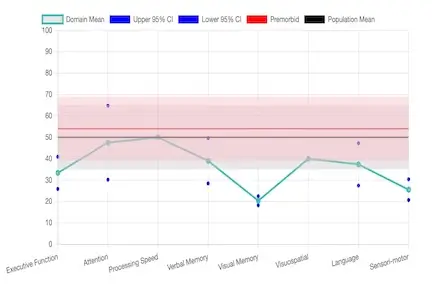
Neuropsychologists test specific abilities to pinpoint the exact nature of the impairment. Impairment in one or more of these domains—especially when it disrupts daily life—warrants comprehensive testing:
- Complex Attention: The ability to sustain focus, divide attention, and efficiently process information.
- Executive Functioning: Higher-level skills like planning, organization, abstract thinking, and problem-solving.
- Learning and Memory: The ability to acquire new information and retrieve past information.
- Language: Understanding spoken or written language, naming objects, and expressing thoughts fluently.
- Perceptual-Motor Abilities: Visual-spatial skills and fine motor speed (e.g., drawing, dressing, or driving).
- Social Cognition: Understanding social cues, recognizing emotions, and managing social interactions.
Why Brief Cognitive Screens Are Often Insufficient
Brief mental status exams (such as the MoCA or MMSE) are commonly used as initial screening tools by primary care physicians, but they have major limitations.
The High-Functioning Mask
Research shows that these screeners may be insensitive to subtle cognitive changes, especially in highly educated or high-functioning individuals. Such patients often possess a high cognitive reserve, allowing them to compensate during simple, timed tests. The screeners may appear normal even when the patient struggles profoundly with complex real-world tasks such as managing investments, completing demanding professional work, or rapidly multitasking.
When clinical concern persists despite normal screening scores—a scenario known as 'passing the screening but failing life'—a comprehensive neuropsychological testing is recommended because it uses significantly more challenging and domain-specific tests.
Diagnostic Clarification: When Neuropsychology is Essential
The core value of neuropsychological evaluation lies in its ability to provide definitive diagnostic clarification. Referral is essential for conditions where the symptoms overlap or the cause is unclear:
Geriatric and Adult Cognitive Decline
- Differentiating Normal Aging vs. Dementia: Neuropsychological testing can differentiate Alzheimer’s dementia from non-dementia conditions with nearly 90% diagnostic accuracy [4]. It helps distinguish between reversible causes (like B12 deficiency or thyroid issues) and true neurodegenerative conditions.
- Mild Cognitive Impairment (MCI): Testing is required to classify the specific type of MCI (e.g., amnestic vs. non-amnestic), which strongly predicts the patient's future risk of converting to dementia.
- Neurovascular Issues: Evaluating post-stroke cognitive changes or cognitive issues related to chronic vascular disease (like hypertension or diabetes).
- Neurological Trauma: Assessing the severity and prognosis of Traumatic Brain Injury (TBI) or persistent post-concussive symptoms.
Differentiating Neurologic vs. Psychiatric Cognitive Conditions
One of the most critical roles of neuropsychological evaluation is distinguishing neurologic cognitive impairment from psychiatric or medical causes that mimic dementia.
- Depression/Anxiety: These conditions can cause cognitive slowing and memory complaints (often called 'pseudodementia'). Testing can reveal performance patterns that strongly suggest mood-related issues rather than a true neurodegenerative disease.
- Medication Effects: Cognitive problems caused by medication side effects or interactions can be identified and separated from primary neurological decline.
Comprehensive testing uses culturally and demographically appropriate norms to ensure diagnostic accuracy for diverse populations.
Pediatric Indications: When Children and Teens Need Testing
For children and adolescents, pediatric neuropsychological testing is essential when learning, behavior, or developmental differences impact school performance or social functioning.
Common reasons for referral include:
- Learning Disabilities: Providing a definitive child learning disability assessment for significant underachievement in reading (dyslexia), math, or written expression.
- ADHD: A comprehensive ADHD evaluation goes beyond rating scales to objectively measure attention, impulsivity, and sustained effort.
- Developmental Conditions: Clarifying diagnosis and treatment for complex conditions like Autism spectrum disorder diagnosis, or genetic syndromes.
- Brain Injury: Assessing the cognitive impact and recovery following a concussion, epilepsy, or other known neurological condition (TBI assessment children).
- Executive Functioning: When a child struggles with planning, organization, managing time, or behavioral control in school (executive function assessment children).
Capacity Evaluation Neuropsychology: Driving & Decision Making
Neuropsychological evaluation is often the specialized service required when objective data is needed to answer critical questions about a person’s functional capacity:
- Driving Safety: Assessing the visual-spatial skills, reaction time, attention, and judgment necessary for safe driving.
- Medical Decision-Making Capacity: Determining if a patient understands the risks, benefits, and alternatives of proposed healthcare treatments.
- Financial Capacity: Evaluating the ability to manage assets, pay bills, and understand complex financial transactions.
- Legal Determinations: Providing objective evidence for testamentary capacity assessment (the ability to make a will) or determining fitness for independent living ability or return-to-work readiness.
These decisions require objective, standardized cognitive data—not subjective impressions or brief screening results alone. A neuropsychologist provides the detailed, legally defensible report necessary for these complex determinations.
Can Neuropsychological Testing Be Done Virtually?
Yes, in many cases, comprehensive neuropsychological testing can be performed remotely, a practice known as Teleneuropsychology. Over the past few years, its validity has been extensively studied, and major professional organizations now support its use [3].
- Validity: Studies show that the results of virtual cognitive testing are generally comparable to those obtained in person, making it a reliable option for diagnosis and treatment planning.
- Convenience: Virtual testing removes travel barriers, making it an excellent option for patients who live remotely, have mobility issues, or prefer the comfort of their own home.
- Hybrid Models: Some evaluations may be conducted in a hybrid format, with some sections completed virtually and others (such as specific motor or visual tasks) completed in person if necessary.
Talk to your clinician about whether a virtual or in-person evaluation is best suited for your specific needs and presenting symptoms.
The Value of Longitudinal Neuropsychological Assessment
Repeat testing (longitudinal assessment) offers unique diagnostic value. Long-term tracking over time helps the team determine whether cognitive impairment is static (stable) or progressive (worsening). This is essential for tracking treatment response, guiding medication management, and planning for the long-term needs of patients and families.
Bottom Line
A neuropsychological evaluation is medically necessary when cognitive changes affect daily functioning, when diagnostic clarity (e.g., type of dementia, specific learning disability) is required, or when brief screening tools fail to capture meaningful impairment. Early referral supports accurate diagnosis, targeted intervention, and better long-term outcomes.
View Neuropsychology Services | View Fees & Scheduling
References
- American Psychiatric Association. Diagnostic and Statistical Manual of Mental Disorders. 2022.
- Mast BT, Benitez A, Levy SA, et al. Evaluation of dementia and age-related cognitive change. APA Practice Guideline. 2021.
- Schroeder RW, Martin PK, Walling A. Neuropsychological Evaluations in Adults. American Family Physician. 2019;99(2):101–108.
- Arvanitakis Z, Shah RC, Bennett DA. Diagnosis and Management of Dementia. JAMA. 2019;322(16):1589–1599.
- Emery-Tiburcio E, Zweig R, Brennan-Ing M, et al. Psychological practice with older adults. APA Practice Guideline. 2024.